Games Couples Play, Part I: Fight Club
By: Ted Harro
Most Couples Have A Fight Pattern
Have you ever been a witness to a rip roaring fight between a couple? Or maybe you’ve been involved in one yourself? If you ever wonder how two otherwise reasonable people can end up in a heated argument – often over something as silly as where to go on vacation – this one’s for you.
When couples get out of sync, each partner has one of two predictable responses to the stress of being disconnected: pursuit or withdrawal. This means that each couple usually falls into a relational pattern when they are in conflict. That pattern becomes a not-very-fun game they play, complete with unspoken rules and strategies of play.
Our ultimate goal is to shift to more productive ways of playing the game, to recreate the circle of goodness modeled for us in the Trinity. But when you’re in the middle of a fight, that’s probably the furthest thing from your mind. Your brain is all stressed out by the disconnection it’s experiencing.
Introducing Fight Club
So let’s start by understanding one of these games couples play. We call it Fight Club.
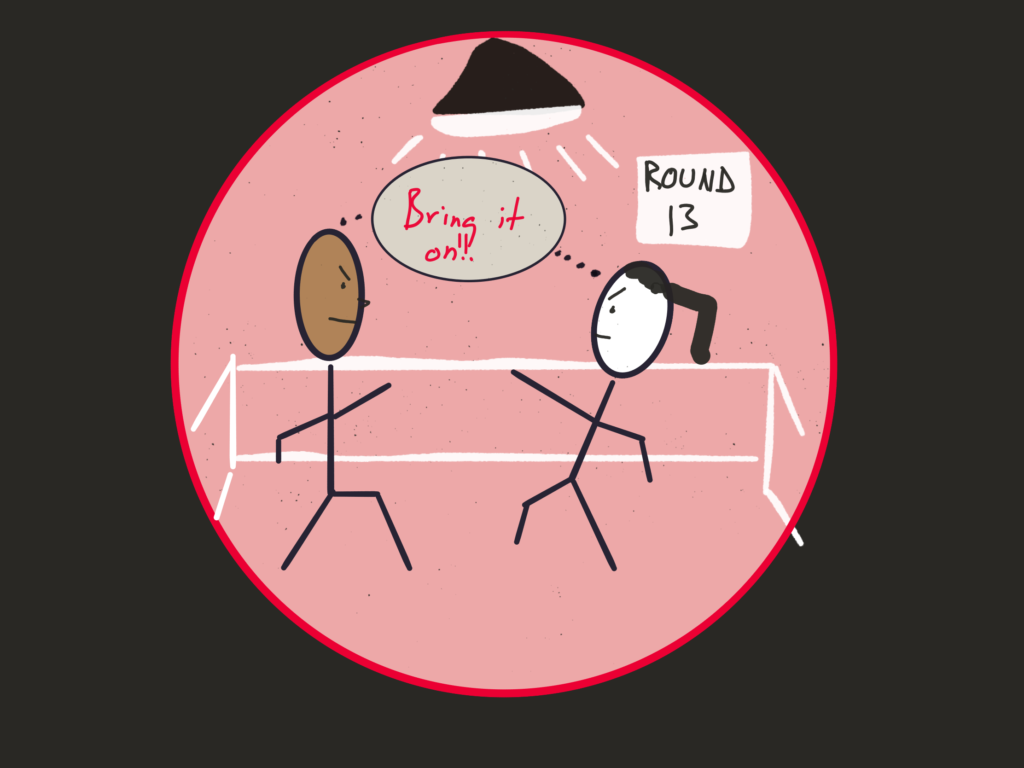
Fight Club, here we come!
Fight Club happens when both partners pursue. Remember, pursuers are like drowning people thrashing in the water. They can look angry or needy. They’re really scared about being abandoned, and sad because they wonder if they matter to their partner after all.
Put two pursuers together and things can get dramatic. Pursuers often look like they’re attacking their partner, guns blazing with criticism and complaints. When their partner sees these aggressive moves, they get fired up too.
Ironically, the more you pursue, the more dangerous you appear to your partner. Left to their own devices, your partner will probably respond to danger by protecting themselves. And if your partner is also a pursuer, that self-protection may very well look like amping up the aggression in return. As the saying goes, sometimes the best defense is a good offense.
You can see how Pursue-Pursue couples wind up in an escalating pattern of thrashing and self-protection. In a strange way, they prefer the attention that comes from fighting to the alternative. “At least he’s not ignoring me,” the pursuer says.
Underneath the frustration and the drama, each partner is getting more and more sad. They’re slowly losing hope that they can have a strong, secure connection. And that’s terrifying.
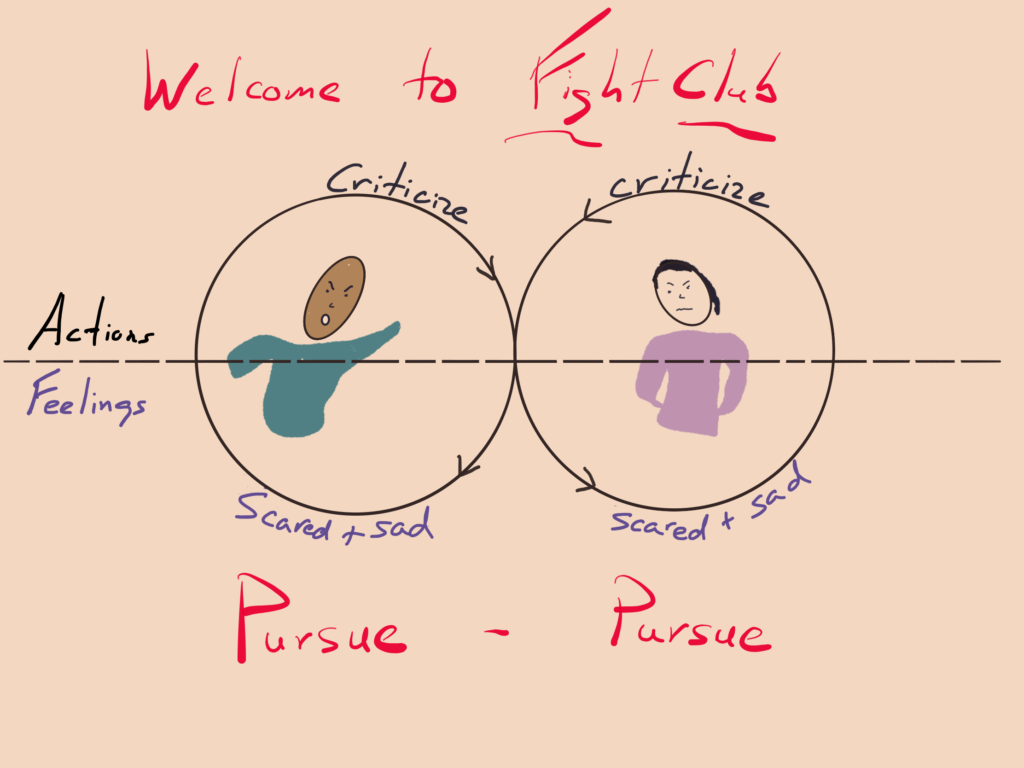
Fight Club Explainer
Yeah, I guess Fight Club isn’t so entertaining after all.
If you and your spouse have a Pursue-Pursue conflict pattern, try this:
- Think about the last time you were in conflict. What was the trigger?
- What feeling did you experience? Try naming it by using the Feeling Word Cheat Sheet. Perhaps even note where you felt the emotion in your body.
- What did you do?
- What did your spouse do? What do you think was the feeling behind these actions? Remember that anger is often the surface emotion, but usually pursuers are experiencing sadness and/or fear.
- Don’t try to change any of these patterns at this point. Just notice them.


2 Comments
Most if not all people have an underlying hurt in their life. Not necessarily understood or even known to themselves. Anger, frustration and contentious behavior is often rooted in the deeper feelings from the past. Couples need to unpack their past with one another, expose, explore and understand why their preferences are worth “dying” for. Understanding your partners hurt explains poor behavior, provides an opportunity to give grace and to be the one to defuse and redirect.
Hi Bart
Thanks for your comment. So true that we all carry underlying hurt into our lives and our marriages – which inevitably affect how we relate to each other. And I love your emphasis on understanding each other as a starting point for participating in the healing process.
I hope you’ll continue reading as – over time – we unpack our belief that marriage is a place where God can do that inner healing work as we cooperate with him. I think it’s one of the best parts of marriage and one we often forget.
Add Comment